No matter how well they do, at some point the PCs are discovered, captured, and brought before Hamanu. – Dragon’s Crown, pg. 33
Oh, the railroad. At some point adventures from TSR transitioned from open-ended affairs to highly structured stories. Some people place the blame squarely on the shoulders of Tracey and Laura Hickman, though this seems a bit unfair. With all the tournament modules that came out in the late 70s and early 80s, it seems like there was always an element of highly structured play available as part of the experience of D&D.
I don’t think railroad games are inherently terrible, but making players play the railroad portions out is definitely stupid. If the adventure you are playing only makes sense if certain situations happen you are probably better off being upfront about that and simply narrating what needs to take place. Otherwise you are wasting everyone’s time.
Freedom, another Dark Sun adventure is even worse when it comes to railroading.
Because the PCs must be captured, the Part One encounters are unfair. One or more PCs will be prisoners after each encounter. No player actions short of the miraculous will save the PCs from eventual capture, arrest, or enslavement.
Why not just start the adventure with the players captured? I can see how organically you could slowly end up sending the PCs to the slave pits: it’s a harsh setting after all. Something about the way this is presented seems obnoxious. But look, there are even dumber examples of railroading in the adventure:
For the purposes of Freedom, you do not want the PCs to escape unless a specific encounter calls for escape. The players, on the other hand, will certainly try to escape. All their attempts should fail. Still the players must believe they had a fair chance to succeed. The following tactics let you program fair failure for the PCs, both thwarting and rewarding their escape attempts. – Freedom, part 2 introduction
Who green lit this module? Freedom is such a spectacularly bad adventure.
I found City by the Silt Sea refreshing because it felt different than most of the other 90s-era D&D books I had read. There are probably lots of modules like this one, though it feels like at the time they were few and far between.
Though the adventure is presented in a particular order, each encounter is designed to stand alone. Like building blocks they form an interesting whole while piled together, but how you stack them is left to each DM. – City by the Silt Sea, pg 5
There has been lots written about railroads in the OSR blogosphere. Most recently, Justin Alexander covered this topic quite well: The Railroading Manifesto.
I recently backed the two Kickstarters that resulted in small boxed sets from Goodman Games. As part of the first Kickstarter I ended up picking up a modules I was missing from their DCC RPG line. I have continued to collect the modules they have been putting out, despite the fact I don’t play DCC RPG or really use modules when gaming. In this fashion I am a bit of an idiot.1
DCC RPG 80: Intrigue at the Courts of Chaos opens with player characters being whisked away to said courts. There is nothing they can do to avoid their fate, but you paid good money for this module so the least they can do it shut up and take their loss of agency like proper friends. Once at the eponymous Courts of Chaos the players negotiate with the various lords of Chaos to determine whether to undertake a quest to retrieve a MacGuffin artifact—well, sort of:
Give the party time to debate the merits and drawbacks of serving the Host, but realistically, unless they choose to martyr themselves for their beliefs, they have little choice but to agree—if temporarily—to accept the Host’s demands.
Well, that seems kind of lame. The “dungeon” the MacGuffin is located within is basically a spoke of 5 rooms, where players are required to visit each room and solve a puzzle to get to the final room and their goal. I thought the presentation of both the lawful plane and the chaos plane was a little bit uninspired. I wasn’t too impressed with this module, though the art is great. I know other people have actually ran it and had a lot of fun, so keep that in mind when I complain about it.
DCC RPG 81: The One Who Watches From Below is a more traditional dungeon crawl. Characters explore a cave that happens to be sitting on top of a temple dedicated to an Elder God. There are eyeballs throughout the adventure, all used to good effect. As usual, the cover art is pretty fantastic.
The adventure features one of the most creative curses I’ve read, which also happens to involve eyeballs. The requirements placed on cursed players would probably make this a tricky module to run online, via a video chat. In person I think playing the curse would be a lot of fun. This is probably one of the better dungeon crawls put out by DCC RPG. Or maybe I just like this curse a lot.
DCC RPG 82: Bride of the Black Manse is another example of Goodman Games branching out from their usual fare. The adventure takes place in a manor home, and is meant to be played over 4 hours of real time. Inspiration for the adventure comes from Fritz Leiber’s The Howling Tower, Edgar Allen Poe’s The Fall of the House of Usher, and Stanley Kubrick’s The Shining. This looks like it’d be a fun module to run. The manse is a small setting, but it changes as the hours tick by in the real world. Players will need to be mindful of how much time they are wasting while playing.
I still have mixed feelings about the DCC RPG line. Many of the modules feel like they have the same underlying structure, which is usually quite linear. This set of modules was interesting because for the most part they are each unique in their own way. Anyway, these Goodman games modules are probably worth the price of admission for the Doug Kovacs covers.
Zak Smith wrote an interesting article on consumerism in gaming. I think in many hobbies there is always a subset of people who participate in the hobby simply by buying things. With photography I knew a lot of photographers who were more into buying lenses and cameras than they were in learning how to take good pictures. Similarly there are people who seemingly buy gaming books, but don’t really use them to much effect, or produce their own gaming work. ↩︎
Fire on the Velvet Horizon is a monster book, but that description seems reductive. Scrap Princess and Patrick Stuart have produced something very avante garde and truly unique. A monster book yes, but one filled with monsters you would have never dreamed up, written and illustrated by two very talented people.
100 monsters are described within the book. They are presented one per page or two page spread. Each page was laid out by hand by Scrap Princess. The book looks like a punk rock zine. Art is done in Scrap’s frantic scribbled style. Scrap Princess would send the artwork to Patrick as it was completed, and he would describe the monster. Scrap’s art is often quite abstract, so it’s interesting to see how Patrick interpreted particular drawings. Scrap and Patrick live on opposite sides of the globe, so I also enjoy this collaboration as an example of how the Internet is amazing.
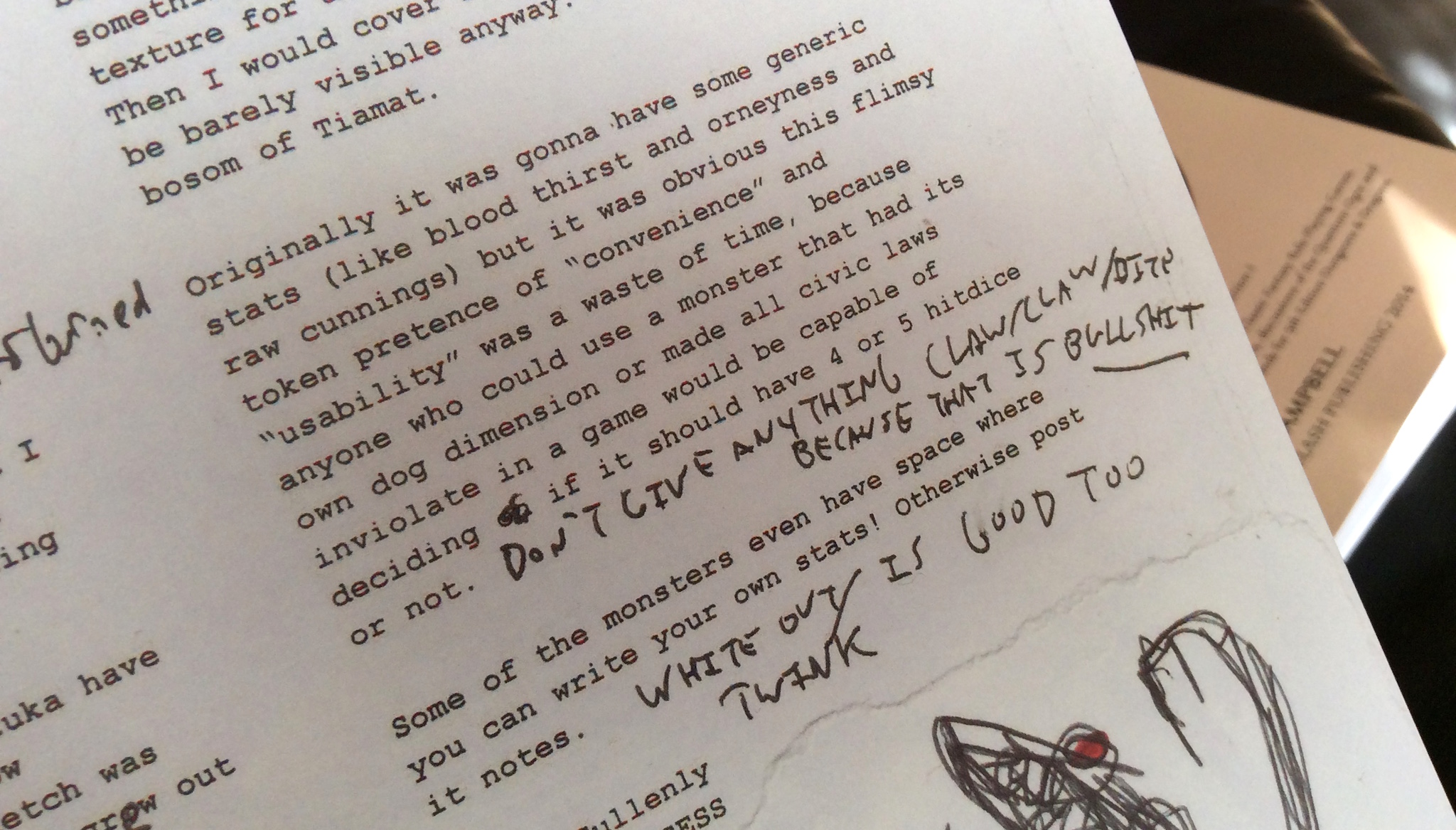
Pictured above is Scrap’s introduction to her new book. The book is systemless. There are no stats for any of the monsters found in Fire on the Velvet Horizon. Each monster is described in great details, but it’s up to the reader to turn the monsters into something more specific for their game. I’ve seen several complaints about the lack of stats in the book, but I agree with Scrap here: stats seem like the ‘easy’ part of designing a monster. (AC 16, MV 90’, 5 HD, ML 8: Done!) This book is 100 adventure, at least. In some cases whole campaigns. Its scope seems bigger than a list of things your players can hit.
I do have one complaint about the book, but it is also a compliment: the layout is crazy! It’s hard to read. At least, harder than a book needs to be. But, the layout is also part of the art. I don’t think it’d be the same book if you had fat margins and blocks of text set to the golden ratio with a nice serif font recreating text from the 16th century. Each page is beautiful so if I need to hold the book a little closer to my face or take off my glasses to read, it’s not the end of the world.
I have barely made my way into the book. Like False Machine I find it hard to read, mostly because it requires (and deserves) your attention and I am easily distracted. The descriptions of the monsters are dense, engaging, and interesting. The descriptions often unfold like stories, with little twists at the end. They are clearly written with an eye for how they would fit in a game. Some monsters are more bonkers than others, but they all have features that would make for fun game play.
The book is most certainly not meant as a table reference. Putting aside the messy zine aesthetic, the writing doesn’t lend itself to quick reference. This is a book to digest slowly. As I have been going through the book I have been noting the monsters I think would fit in my Carcosa game, and then making a small OD&D entry for them that I could use during a game. This seems like the best approach to using the book.
So yeah, this book is good and you should buy it. Patrick and Scrap are making the books no one else is making. This is one of the best examples of what the DIY D&D scene can produce.
You should do a post … having DMed several sessions, about what you find Carcosa brings to the table and what you’ve done to make it “yours?” — Cole Long
I write reviews for gaming books I never actually use to game, which feels kind of dumb but what can you do? Now with Carcosa I can actually comment on the book with insight from using it to run a D&D campaign.
I’ve ran 7 games of Original D&D game set in Carcosa. The original idea for the game was to mix in elements from Masters of the Universe into the Carcosa settings, but that hasn’t quite happened just yet. I’m really not familiar with most of the literary references that inspired Carcosa, which makes running the game “interesting”.
I wanted my campaign to start in a Lawful settlement. I had catalogued all the settlements in the game as a byproduct of working on my Random Carcosa web application. The highest level Lawful leader in Carcosa is 11th level and can be found in Hex 1011, along with a crazy robot.
Village of 270 Bone Men ruled by “the Swift and Silent Beginning,” a lawful 11th-level Fighter.
The unwary may fall prey to a deranged, spherical robot (AC 18, MV 180′, hp 25) with treads and retractable appendages, nets, self-repair, infrared, and long-distance vision. It will seek to abduct stragglers and take them to a small, hidden outpost to be shackled in close proximity to radioactive waste. Each hour spent thus requires a successful saving throw to avoid mutation.
I printed out some hex graph paper and drew the region around this hex, marking down the settlements and their allegiances to the battle between Law and Chaos. The official Carcosa map in the book is missing this information, which would have made it about a million times handier. Zak Smith drew in his Carcosa book, but I just can’t bring myself to do that.
There are slavers nearby in Hex [REDACTED] terrorizing the region, and so I made them the main threat in the game. I decided the town of Invak would offer refuge to former slaves. This would explain why a party of PCs would likely include people from the various races of Carcosa. Chaotic villages close to the slavers were likely to supporters, as were Neutral villages nearby. Villages closer to Invak would be against slaving. Invak would be a bastion of egalitarian and progressive thought, in another wise terrible world. The town to the South of Invak became a trading hub, liking Invak with a few other towns near by. In this way I fleshed out the relationships between the various villages in the area.
I answered Jeff Rient’s 20 Quick Questions about your Campaign, which helped me think more about what my game would be like. From an older blog post about Carcosa I knew “the Icon of Judgment” was the strongest sorcerer in the world. I made some rough notes about what his deal might be, but thus far it hasn’t really come up in play: mostly because I haven’t brought him up at all. The castle of Chaotic Orange Men North of Invak became a crazy cult running bizarre gladiatorial games.
I drew a map of the hidden outpost. It seemed like a good dungeon to begin the game with. Players would start shackled in the radioactive wastes. I introduced a small group of Bone Men, who were hiding out inside this outpost. They had imprisoned one of their members for [REDACTED]. The robot would only be ‘active’ at night, and would only travel through the wilderness, so the players wouldn’t have to worry about it unless they specifically tried to instigate a fight with it. There were also lasers, spawn, and other things that felt like Carcosa.
This was enough to start playing. I ran a session with Gus and Eric, two of the regular players from my Monday night D&D group, and things continued from there. I am constantly underprepared for each session we play, but things usually work out—for the most part.
Eero Tuovinen has done an amazing job with the layout of Carcosa. Carcosa is a well laid out book that works well at the table. I flip through it often looking up monsters, hex descriptions, and the like. Most everything is easy to find, and more importantly easy to read. McKinney has a very terse and direct way of writing that I like. He manages to be evocative without wasting too many words—usually.
In terms of helping you build a campaign, Carcosa brings barely any information to the table. The book succeeds in selling the idea of Carcosa, without really telling you that much about it. Are all the races identical besides their colour? Do they all share the exact same culture? Are their multiple languages in the world? What are the towns and villages like? What do people eat? What’s a GP in Carcosa? There are so many questions about the world that are unanswered. Explicit relationships between hexes are few and far between. This encourages the sort of brainstorming I did to get things going, but is also one of the big criticisms of the book: it all feels so random. I would have loved for some discussion from McKinney on how he explicitly organized and ran his game.
The big win for Carcosa is that I never feel like i’m doing it wrong. I never have to look something up so-and-so important NPC, or double check the date such-and-such event took place. Carcosa is a loose framework for building your own Carcosa. I’m not sure I have done that great a job of build my own Carcosa, but i’m hoping that I am not too far off.
Night Witches was released to the public a few days ago. The game was produced as the result of a successful Kickstarter—like most games nowadays—and has seemingly been in the works for years now. The game caught my eye because it features artwork by Rich Longmore, the illustrator of Carcosa. $12 for a PDF of new Rich Longmore art feels like a steal. The fact there was a whole game that came with it was a nice bonus. And so it came to pass I bought my first story game.
Night Witches is a game with a very specific focus. Everyone plays Russian fighter pilots from the all women 588th Night Bomber Regiment, who the Nazis referred to as the Night Witches. I play in several D&D campaigns right now and they are all over the map when it comes to setting and tone. House rules might differentiate the games slightly, but for the most part we are all playing D&D. People in the D&D scene will add or drop rules to shift the focus of D&D slightly. Someone into dungeon crawls will focus on light and encumbrance rules. Someone interested in horror might introduce sanity rules. These sorts of tweaks seem minor when you look at a game like Night Witches. The whole game exists to support this very niche experience.
The game play in Night Witches is fairly straight forward. Play is split into two phases: days and nights. During the day you role play the action that happens on the airbase. At night you fly bombing missions and try to kill nazis. Night Witches is based upon the rules for Apocalypse World. Action is free-form until you do something that would require you making a Move. These are the pivot points in the game. Moves are specific: you eyeball someone or act out. There are a handful of moves each character can perform. The analog to characters classes in D&D are natures in Night Witches: someone has the temperament of a hawk, or an owl. Natures grant additional moves characters can learn as they level up. In this way the game feels similar to 4th Edition, with its discrete list of powers. I’m curious if this feels as stifling as I found it with 4th edition. Are players who are good at eyeballing going to constantly try and give everyone cut eye to get their way? (Maybe I just played 4e with goofy players.)
Night Witches seems to be first and foremost about collaborative story telling. At least, this is what it seems like coming to the game from D&D. I’m curious if all the bonuses you collect and moves you have are in fact far “gamier” than they sound on paper. There is probably a tactical element to succeeding in your air missions that is more evident in play. (Not that i’m particularly interested in that sort of thing. I like playing OD&D because there are barely any rules.)
In Night Witches characters each have 4hp (marks), and when you use them all up you are dead. The way this works sounds similar to the Grind in a Torchbearer. You get progressively more stressed and injured, culminating in your passing. Character death looks to be the likely outcome for most characters in a long running campaign. My assumptions about story games were that this sort of thing was uncommon. (In contrast to the meat-grinder D&D games I have become used to.)
There’s a lot to like about the rule book. The book is well laid out, both in terms of how it looks and how it functions. It opens with advice on where you should start reading, based on your experience with table top games and Apocalypse World games. The start of the book has all the player facing rules. The middle of the book has the rules the GM would need to run a game. There is advice on running your first session, how to teach people the game, etc. Most of the rules for the game fit on the character sheet. (Again, something that was common in 4th Edition, and apparently how all the Apocalypse World inspired games work.) I suspect it’d be easy to use the book during play.
The new artwork by Rich Longmore is fantastic. I have no regrets about picking up this book. My only gripe is that there isn’t more Longmore art. The other artist featured in this book is Claudia Cangini, who did head shot style comic portraits of women from the 588th Night Bomber Regiment.
I still haven’t played Night Witches. I’m not sure when i’ll get the chance. Hopefully sooner rather than later: it seems neat and it’s certainly different.
Dwimmermount is a beast of a book: several hundred pages long and packed full of pulpy science-fantasy. The dungeon was developed and written by James Maliszewski of Grognardia fame, but edited and published by Tavis Alison and Alexander Macris from Autarch. Dungeon of Signs has a thorough review well worth reading. I agree with much of what Gus has to say about the book.
Translating sparsely worded notes into something that not only makes sense to others but is thoroughly usable by them is harder than it looks, particularly when one has, as I have, come to appreciate firsthand the benefits of sparseness. Having run many levels of Dwimmermount numerous times with groups of different gamers has taught me to find liberation in a certain degree of vagueness, as it gives me flexibility to tailor the dungeon to whoever is currently sitting at the table with me.
There was clearly a disconnect between James and Autarch when it comes to the level of detail expected of a D&D module. The introduction to Dwimmermount touches on this. Autarch finished the book, and so had the final say when it came to the descriptions of the rooms in the dungeon. They are often quite long. Many people seem quite happy with this outcome. I find the level of detail a bit overwhelming. Often times rooms describe things that really don’t need to be spelled out. I prefer terser descriptions: it’s easier to parse out what’s important.
Level 3B begins as follows in the printed version of the book:
In the south-west corner of this room is a tall fountain constructed of white alabaster. The fountain’s surface is decorated with arcane symbols, while the fountain’s basin is visibly discolored, being darker, almost blackish, in places. Covering the basin is a vitreum canopy.
At present, the fountain is not working. If the Power Generator (Room 10) is turned on, the fountain can be activated from the Control Room (Room 3). If activated, the fountain begins to circulate azoth. The vitreum canopy covering the fountain protects spectators from being splashed by the toxic quintessence, but equally prevents them from gathering it. The hemisphere is immune to damage from weapons and similar physical attacks, but if it takes more than 50 points of damage from spells or magical effects, the material will shatter and allow direct access to the fountain itself. 7 gallons of azoth can then be collected per minute, up to a maximum of 1,200 gallons, although this can only be safely done by a character in an environment suit. See Appendix F, Azoth (p. 379), for more details on the properties of azoth.
The areonite pipes that feed the fountain are too small for humanoid creatures to traverse, and highly toxic besides. If the characters somehow get into the azoth pipes themselves (e.g. by diminution), see Chapter 6, Overview of the Dungeon, p. 77, for details on where they might travel.
The room is currently occupied by four throghrin, who guard the steps from Rukruk’s Throne Room (Room 34) on The Reliquary (Level 2B) from interlopers on this level.
Throghrin (4) [AL C, MV 120’ (40’), AC 6, HD 3, HP 13, 12 (×2), 10, #AT 1, DG 1d8 (battle axes), SV F3, ML 10]
The throghrin keep a chest containing 3,000 sp near the steps. If hard-pressed by attackers from this level, the throghrin will abandon this treasure and retreat upstairs, hoping the chest will distract intruders long enough for them to gather reinforcements.
That’s pretty meaty. Who is going to get through that sitting at a table? This is one of my big complaints with a lot of the Goodman Games modules as well. A lot of room descriptions are interesting, but also far too long. Actually, this is probably a fair complaint of most modules published today.
James’ draft of this room for the book is a bit shorter, but hits a lot of the same notes.
In one corner of this room is a strange fountain made of whitish stone and decorated with arcane symbols and covered with a glass-like material. The fountain’s basin is visibly discolored, being darker, almost blackish, in places. At present, the fountain is not working. The controls to activate it can be found in Room 3. If activated, the fountain begins to circulate azoth. The material covering the fountain is immune to damage from weapons and similar physical attacks. However, if it takes more than 50 points of damage from spells or magical effects (wands, etc.), the material will shatter and allow direct access to the fountain itself.
The room is currently occupied by four throghrin, sent down by the hobgoblin king on Level 2B.
Throghrin (4) [AL C, MV 120’ (40’), AC 6. HD 3, HP 13, 12 (x2), 10, #AT 1, DG 1d8, SV F3, ML 10]
The throghrin have a chest containing 3000 sp that they guarded zealously.
He doesn’t spend time talking about gallons of Azoth, or go into too much detail about the what needs to happen to re-activate the well. Both descriptions suffer from burying the lede: they discuss the monsters currently occupying the room after talking about an inert well and how one might go about reactivating it. What’s more important the moment a player walks into this room? This seems like the sort of thing that should come up while editing a book. (I guess the stat block stands out regardless of where it is in the description.)
From seeing James’ rough play notes for other levels of this dungeon, and seeing how he has run games in person, my educated guess for what the original room description was is the following:
Wonder & Wickedness was released at the end of 2014, within a week of Zak releasing A Red and Pleasant Land and James publishing his new zine The Excellent Travelling Volume. December was an action packed month for gaming. I had been following along on Brendan’s blog as he published early versions of his “Spells Without Levels”, and read an early draft of what would ultimately become Wonder & Wickedness. What was finally published is much grander in its scope and vision.
Wonder & Wickedness re-imagines magic for Dungeons and Dragons (and its ilk). The primary conceit of the whole supplement is that spells are not subdivided into levels of progressively more powerful spells. Spells are broken down into schools of magic, arguably a more evocative arrangement. Each spell is designed to be used from first level onwards. They either scale in power, or posses a utility that goes beyond hit points. We have 7 schools of magic—Diabolism, Elementalism, Necromancy, Psychomancy, Spiritualism, Translocation, and Vivimancy—each with 8 spells, for 56 spells total. The book begins with the original magic spells from OD&D’s Men & Magic booklet as its primary influence, and recreates them in novel ways. This initial list of spells is then expanded upon so that each school of magic has an equal number of spells.
For some spells, their original inspiration is clearly visible, though I find the re-writes more fantastic. In Men & Magic we have Read Languages:
The means by which directions and the like are read, particularly on treasure maps.
This becomes Comprehension in Wonder & Wickedness:
The meaning of obscured or indecipherable communications is laid bare. This spell may be used to understand the words of any language or read the true intent of a cyphered missive. Even spirit or animal speech, such as the groaning of clouds or the howling of wolves, may sometimes disclose their secrets.
The reworking of Light, which becomes the Diabolism spell Gleam, is great. Ones natural inclination is to assume Light would be some sort of holy spell, not the result of demon worship.
Conjure a hovering magical spirit of radiance that does not shed heat, does not require air, and is not doused by water. A gleam per level may be summoned and the illumination of each is similar to torchlight.
Gleams may be directed to bedevil enemies, which will cause temporary blindness if a saving throw is failed as long as the spirit remains engaged.
I find the magic presented in Wonder & Wickedness is flavourful in a way much of the magic in most editions of D&D is not. The edges around each spell are looser than they are in later editions of D&D, in this way staying true to their roots. Spells here aren’t simply cheat codes for various game mechanics. Brendan remarks on his philosophy in designing the spells in the books foreword:
I attempted to be suggestive rather than comprehensive. This is in the spirit of the original game, and means that the text cannot foresee every possible outcome. The Referee will be required to make rulings. Can poltergeists be damaged by magic? How are they permanently banished? I prefer to think of the spells here as a point of departure, not a voice of authority.
Following the spell descriptions are magical catastrophes. Each school has 12 corresponding catastrophes, giving us 84 catastrophes total. These are all over the place when it comes to their effects and severity. They are one of my favourite parts of the book.
Several lesser air elementals are imprisoned within the sorcerer’s body. Each time the sorcerer casts another spell, one is released and must be dealt with (standard reaction procedure applies, and there is a 1 in 6 chance that any such elemental released will be the last). These elementals may steal any words the sorcerer attempts to speak, and the sorcerer will naturally float atop water as long as any such elementals are contained.
I was hard pressed to pick an example catastrophe. There isn’t any one that serves as a good example of what the others are like. They are each quite unique.
The book ends with a listing of 50 magic items. Like the spells presented earlier in the book, these magic items are far more interesting than what you find in a typical D&D book. There is an implied world suggested by these items, and the spells, that is lovely and creepy. I won’t spoil any of them by reprinting one here. They all manage to convey a lot of ‘magic’ without a lot of needless verbiage—something I have noticed in a lot of the magic items I see shared on G+.
I would be remiss if I didn’t point out that the entire book was illustrated by Russ Nicholson. Perhaps i’ve buried the lede by mentioning that here? Anyway, hells yes. His new drawings for the book are straight-up amazing.
The books layout and design is beautiful. The book is A5 in size, with single columns of large text on each page. It’s nice to read on my iPad mini. I’m sure it’ll be twice as nice as a physical book. As noted, most everything in the book is prefixed with a number, making it easy to randomly roll for magic items, spells, or catastrophes as needed.
Wonder & Wickedness was one of my favourite books from 2014—and there were lots of great books in 2014. If I ran a fantasy D&D game i’d definitely use this book as the basis for how spell casting works: it’s better than the original. What!
James Raggi recently ran a contest soliciting magic items for the new LotFP Referee book. My entry didn’t make the cut, so you get to enjoy it right now. I think it’s pretty LotFP.
A simple looking leather bag, with drawstrings to hold itself shut. A crude image is burned on to one side of the pouch. Like a Rorschach print, it’s unclear what image the artist had wished to convey. A face, perhaps?
That bag is full of sweets: liquorice and other such things. When opened it is so full the candy almost spills out. The owner of the bag may draw out any number of sweets, fistfuls at a time if they desire. There are always more sweets in the bag. These sweets are unremarkable: tasty, but likely to give you a stomach ache if you eat too many.
Upending the bag will cause all the candy to fall out: one small bags worth. And then the bag is empty, its magic gone.
If anything else is placed in the bag—a tough feat, the bag is bursting after all—the bag looses its magic: when opened next it will be empty.
If someone who does not own the bag attempts to draw candy from it, there is a 50% chance the candy is both tasty and poisoned (save vs. poison or die in d6 turns, bleeding from all orifices during that last turn of life).
The owner of Nan’s Bag of Sweets will feel a supernatural compulsion to offer candy from the bag to any children they encounter, the voice of old Nan echoing in their head. (Save vs. Magic to resist the bags charms.) Children always draw poisoned candy from the bag.
Potions and poultices prepared by an experienced hand can temper the addictive and dangerous properties of the desert lotus, producing powerful restoratives. There is always a risk associated with the lotus, but they are perhaps greatly outweighed by the rewards.
d20
Item
Description
Cost
1
Green Lotus Poultice
Restores a dCarcosa of hit points to a wounded character. Takes 1 turn to apply.
1d6 x 50GP
2
Green Lotus Potion
Ingesting this potion will restore 2dCarcosa hit points.
1d6 x 100 GP
3
Black Lotus Poison
A slower acting variant of the deadly Black Lotus Powder. Those ingesting this poison will die in dCarcosa days if they fail their Save vs. Poison at -6.
1d4 x 1000 GP
4
Jale Lotus Potion
This mind expanding potion grants the character d6 psionic wild talents. Each can be used once, over the course of the day, while the drug slowly works its way through the characters system.
2d6 x 200 GP
5
White Lotus Potion
Cures those afflicted by the effects of White Lotus Powder
1d10 x 100 GP
6
Blue Lotus Potion
Ingesting this potion fills a person with a deep sense of calmness. Characters are immune to all fear effects. This potion is a favourite of Sorcerers who wish to commune with terrifying Old Ones.
1d4 x 100 GP
7
Blue Lotus Poultice
Applying this poultice takes one turn, after which a characters skin will feel completely numb. Characters are immune to damage from extreme cold, heat, and acid. This effect lasts 9-12 hours.
1d10 x 100 GP
8
Yellow Lotus Powder
The powder distilled from the beautiful Yellow Desert Lotus produces the most horrific waking dreams when inhaled. Characters must make a Save vs. Poison or go completely mad, physically paralyzed, their mind trapped in a terrible nightmare.
1d10 x 100 GP
9
Yellow Lotus Poison
This poison is a powerful paralytic, usually applied to the tips of arrows and blades. Characters must make a Save vs. Poison or be unable to move for 1d6 turns.
1d10 x 100 GP
10
Bone Lotus Poultice
Applying this poultice takes one turn, and renders the character skin and organs translucent like those of a Bone Man. This effect lasts 9-12 hours.
1d6 x 50 GP
11
Bone Lotus Potion
Drinking this translucent potion will render the imbiber gaseous, allowing them to pass through anything that isn’t air-tight, and making them impervious to most attacks.
1d10 x 100 GP
12
Purple Lotus Powder
When mixed with other slow burning herbs and smoked this powder acts as a depressant, relaxing the mind and making its user completely open to suggestion for 1-4 hours.
1d6 x 50 GP
13
Orange Lotus Potion
Produced using the sweet nectar found within the buds of the Orange Desert Lotus, this potion grants super-human strength to those who drink it. Characters do an additional dice of damage when attacking with melee weapons. This effect lasts dCarcosa turns.
2d4 x 100 GP
14
Ulfire Lotus Poultice
Applying this poultice takes one turn, and leaves the characters skin feeling dry and rough. Characters gain an addition +2 to their AC and to their saving throws where applicable. This effect lasts 9-12 hours.
2d6 x 100 GP
15
Ulfire Lotus Potion
This potion is a powerful anti-poison, nullifying the effects of any lotus based poison or powder.
1d6 x 100 GP
16
Brown Lotus Poison
Typically applied to the tips of arrows, this poison instantly kills those who fail their Save vs. Poison.
1d4 x 500 GP
17
Dolm Lotus Potion
The character feels a quickening of their body and mind as this potion takes effect. Characters double their movement rate, and start combat at the top of the initiative order. This effect lasts 1d6 rounds.
1d4 x 500 GP
18
Dolm Lotus Powder
When smoked as a powder this lotus produces an unnatural lethargy (and euphoria) in its user. Characters regain dCarcosa hit points, but are unable to do anything besides lay around for 1d6 turns.
1d4 x 50 GP
19
Red Lotus Poultice
The restorative power of the rare Red Desert Lotus is without equal. Rubbing this poultice over a dead character’s body will restore them to life, assuming they fail a Save vs. Poison.
2d6 x 1000 GP
20
Red Lotus Potion
This potion fills the drinker with supernatural vigour that lasts 9-12 hours. If killed while under the effects of the drug the character will instantly return to life with dCarcosa hit points, as their body absorbs all the red lotus in its system. (This effect can only occur once.)
2d6 x 1000 GP
Each usage of a potion or poultice produced by a desert lotus apothecary has a 1 in 20 chance of producing a great feeling of a addiction in the user. All powders have a 1 in 6 chances of being addictive. Players who are currently addicted to what they have just ingested must take another dose (which grants additional positive effect) or be at a -1 on all rolls for the session. Using a desert lotus product more than once a session increases the chance of addiction by 1, 2, 4, 8, etc.
Apothecaries that work with the desert lotus will generally have a random selection for sale week to week, prices varying based on the availability of flowers.
The default setting for Carcosa is full of xenophobia. I wanted a list of reasons why a group of adventures of various races might be adventuring together. I started writing one, but got stuck fairly quickly. So, I asked my friends to help out. The good entries below were all written by people other than myself. They call that Gygaxian Democracy.
Why are we together?
Awoken from a lotus induced stupor you have fled from a sorcerer. I’m sure they want you back.
Escaped from Slavers! One day you will have your revenge on those bastards—unless they get you first.
Members of a traveling troupe of actors. You know one play, which you tweak based on your audience to play up on the local prejudices.
Members of a janissary regiment, put together by long gone—perhaps?—Alien overlords.
After years of wandering with your herd the symbiotic fronds were yanked out from the backs of your heads. Who knows how many years you lived as root heads.
Returned to Carcosa after being experimented on by the Space Aliens. Hopefully they don’t come looking for you again.
Cultists! (Must share a common alignment.)
Foundlings raised by Lawful spawn hunting illuminati.
The wrong coloured children of an otherwise homogenous village. Did they treat you well?
Refugees who have fled a natural disaster. Famine? War? God damn Aliens with laser guns?
Kidnapped orphans raised deep in the desert by a mad, but kindly, old couple.
Psychically summoned to a crashed space ship. You have no memory of the recent few months.
Members of a diseased community of outcasts. Everyone shares a common (mostly harmless) mutation.
Emerged from a sorcerer’s birthing vats deep within an abandoned complex. (Thousands of other pods full of replacement PCs available as well.)
Once from a religious community, where all members wore body obscuring clothes and lived as equals without colour based caste. After the sorcerer’s troops/raiders/slavers/shaggoths came that dream, and the obscuring robes and windings, have been cast aside.
A bad medicine show went through some villages a while back selling poisonous mutation causing ‘snake squeezings’. The adventurers are relatives of the slain, banded together to hunt down huckster and deliver ‘justice’.
All that remains of the local criminal underworld, driven out by an unspeakably violent new boss or spawn inquisitors.
Each character bears the same tattoo, which causes horror amongst village elders Carcosa wide. (The characters have no memory of when or how tattoo appeared.)
The former retainers of a group of strangely coloured people who spoke a weird language and claimed to be from another world called Dirt (or Earth or something like that). The original adventurers are all dead, but retainers continue to adventure together. Some continue to search for a portal to this world of Dirt, because there are no shoggoths there.
You each have vague memories of a past life as a White Man sorcerer, until you performed some ritual that split you into different facets of your core personality.
In the game I am running now, the players rolled a 3 when starting the campaign. So, they are all members of the acting troupe The Rainbow Connection. Their back story has been far more fun than I had thought it would be.
Thanks to Stuart P, Brendan S, Evan W, Gus L, and David R and everyone else for their ideas and suggestions.