They announced the latest edition of Warhammer 40,000 last night at AdeptiCon. I never even managed to play a game of 9th edition, the pace of their releases feels a bit ridiculous. I had told friends I was going to ignore whatever comes next in protest. Except, in a real plot twist, everything they’ve announced sounds weirdly amazing. The rules are going to be free. The army rules, normally sold as (expensive) Codex books are also going to be free. The rules are going to be simplified. (No more lists and lists of strategems!) I am curious if they can pull this all off—and fight the urge to sell you 50 new strategems in a few months.
I have described the hex descriptions of Carcosa as tweet sized bites of information, descriptions you can quickly read in the midst of a game. They are both flavourful and useful. Well, sometimes. Sometimes they are too terse. Terse descriptions and bullet points can become too utilitarian, too boring. I often find it hard to read adventures written in this style because they are so dull. Silent Titans and Luke’s own Gradient Descent are both good examples of marrying beautiful writing written out in bullet points. I found both easy to run and read. (Patrick’s module is still quite wordy as that style goes, mind you.)
Of course, a lot of D&D books will never be run, simply read. I suspect this is actually the more common use case. DMs may harvest your book for ideas, a room or NPC, or simply something that will live in their brain. It’s perfectly reasonable to optimize for reading over play: sacraligous, I know.
I finished reading the rest of Demon Bone Sarcophagus this morning. This adventure is a big dungeon crawl, a tomb for the Empress of Fire, now resting in the titular Demon Bone Sarcophagus. The adventure was made by Patrick Stuart and Scrap Princess, produced as part of a Kickstarter that concluded during the pandemic. I waited for the hardcopy to arrive before giving it a proper read.
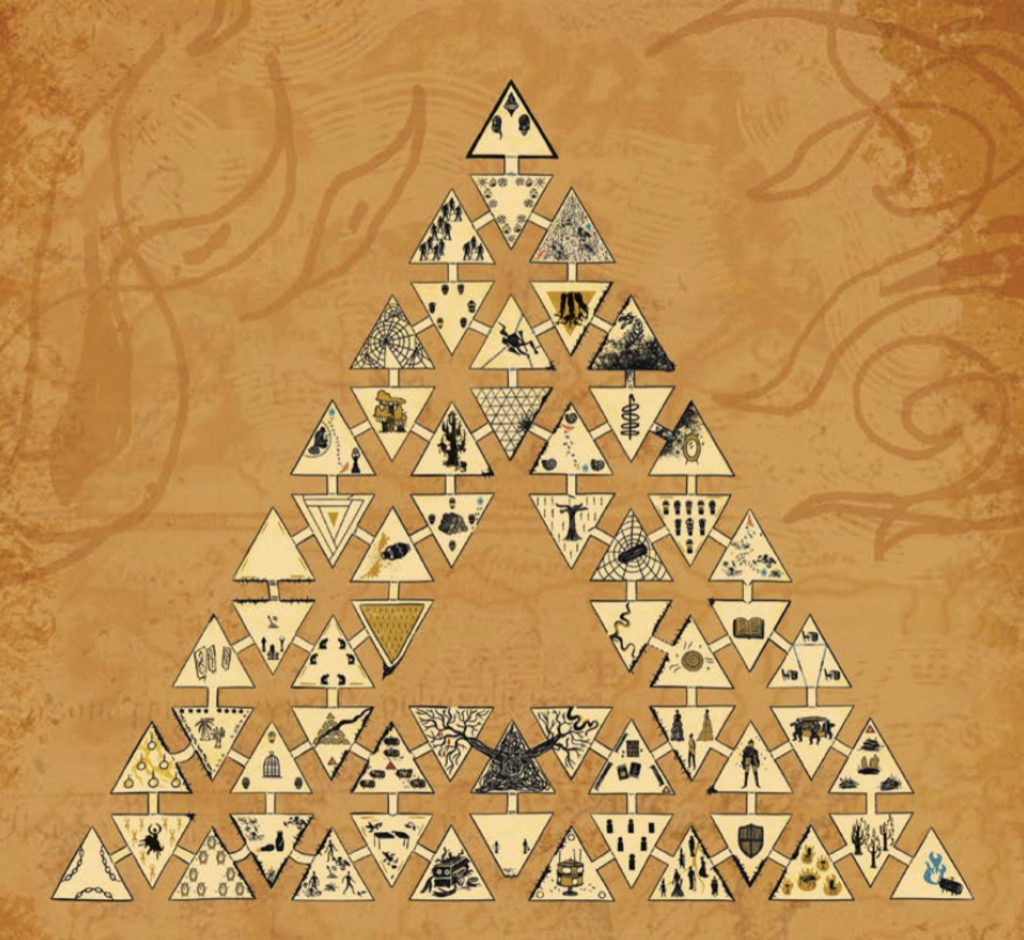
The dungeon is a giant triangle, composed of smaller triangles. You can see the player facing map above. This layout feels a bit repetetive, because it is, but the choice is likely thematic and meant to evoke the fire triangle (ignition, oxygen, fuel). The choice also produces a dungeon that is very interconnected. There are lots of paths through the dungeon. There are tunnels made by a giant sloth running through the complex as well, which is another layer of interconnection. Players may break their way into these tunnels, or rooms may collapse into them during play. There are “glass girls”, acid golem monsters, wandering above the tomb that players can attempt to use to blast new holes into the dungeon, creating yet another layer of interconnection. The dungeon itself feels quite dynamic in this regard. I’m not sure I’ve read an adventure that expects the layout to change so much through play: can you think of any?
It’s a bit of a fun house dungeon, each set of 4 triangles that compose the larger tomb thematically linked. I’m not sure there was actually that much utiltity in reading the whole thing up front, versus quickly skimming things and playing a little bit by the seat of your pants, like god intended. I think being familiar with the factions and people that are wondering the tomb is likely more important, and they are presented up front.
The rooms descriptions are verbose. It feels like everyone nowadays copies what has become the house style for Old School Esentials, which likely originated with Courtney Campbell’s posts on writing room descriptions: terse, bullet points, information revealed in the order players will encounter it, etc. Silent Titans is written this way, and I think is a great example of how you can marry great writing with this more utilitarian style. Demon Bone Sarcophagus feels a bit old school in its presentation by comparison. That the typography and copy editing are sloppy does it no favours here either. There is lots of evocative stuff throughout this dungeon, but some rooms are hard to quickly parse.
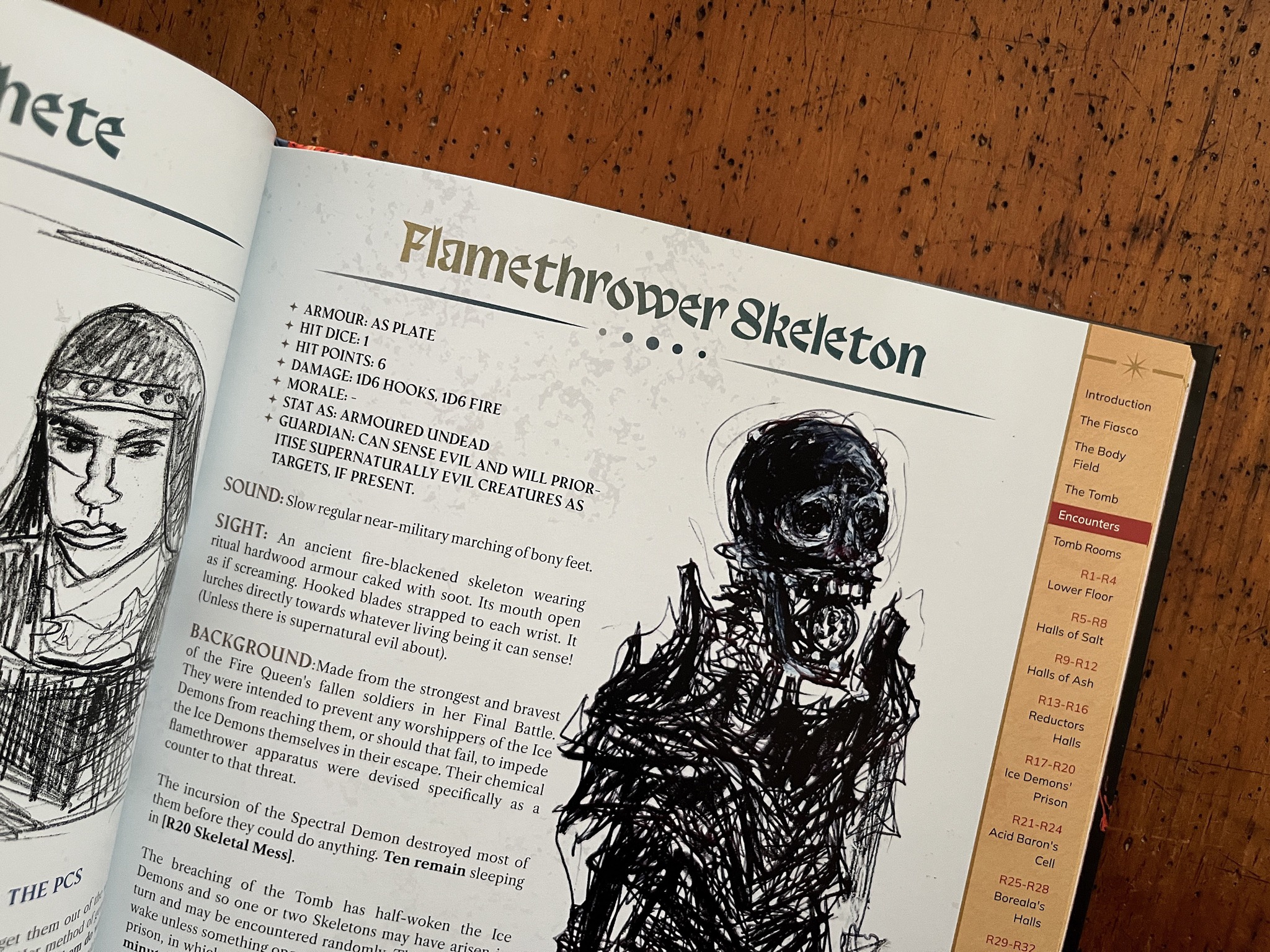
There are some great pieces of art from Scrap in this module. I love the version of the Reductor, one of the NPCs in the book, that is featured on the back cover of the module. It manages to look backlit. If you like Scrap’s art you’ll like what we have here, if you don’t you won’t. There is a good mix of work from Scrap: simple B&W illustrations to full colour pieces.
Scrap and Patrick have a good eye for what will make for a good adventure. You can feel all the stored kinetic energy just waiting to burst on these pages. I love all the random encounter tables, each entry a monster or NPC paired with the action they are performing. Many entries feel like they might be the centre of a fun night of gaming. The opening of the adventure, like Patrick’s other adventures, opens with a bang: the players stumble upon the aftermath of a huge fight, characters from various factions lay dead and dying everywhere, while key members have fled into the tomb. Like everything this team does, it all feels quite unique, even though it’s just a dungeon crawl through a tomb.
These are just some quick thoughts after having read the module. I am keen to run this soon. It looks like it’ll be fun to play through. I’ll report back on how that all goes.
Patrick could have given this monster a dumb fantasy name, but like a true professional tells you what it does on the box.
Demon Bone Sarcophagus seems a little intimidating to me. There is lots going on within this book. Lots of text to kick things off. Lots of text throughout. It all feels quite dense. Scrap mentioned that a lot of the text in the book is there to help orient the DM to what’s going on, to make it an easier adventure to run. Fair enough: let’s read this thing!
The book opens with a bunch of backstory that’s all tucked away in one place, so you can just skip past it like a true Patrick Stuart fan. The book doesn’t jump straight to the dungeon, but presents its bestiary first, like Veins of the Earth. The bestiary doubles as a nice dramatis personae for the module. Adventuring through the dungeon looks like it’ll involve a lot of mucking about with NPCs and so learning about them upfront is a good idea. Everything you need to know about the NPCs in monsters is consolidated in one place, but if there are interactions between the creatures and the dungeon, that information is repeated in the room descriptions as well. As was the case with the secend edition of Deep Carbon Observatory, this book is broken down into (mostly self contained) spreads. You should be able to run the adventure from the book without a lot of faffing about. In theory, anyway. I’ll report back once I’ve run this thing.
I’ve been reading the book on and off this weekend, making it through about half the book. Sometimes I have big plans to write about these books I like, but never get around to it because I have too much to say and the weight of figuring out what to write is too much. This time around I will share thoughts as they come to me.
BreakoutCon is this weekend. Sadly I will miss it, i’m out and about, but I did manage to meet up with some friends last night, before the convention began in earnest. It was a bit of a G+ reunion. Zzarchov drove down from middle of nowhere Ontario. Richard G drove up from Upstate New York. We rounded out the posse with some torontOSR regulars: myself, Brendan, Alex, and KYANA. What a crew! KYANA gave everyone G+ buttons she made. An advantage of meeting up with Zzarchov is you get to see what he’s been up to in the flesh. He had new reprints of several of his books, including one of my favourites, Scenic Dunnsmouth—a true classic of the OSR. The book was kickstarted as part of the Kickstarter for City of Tears. It still features Jez’s amazing art and layout. I assume you’ll be able to buy it soon. This is me giving you notice to start paying attention to Neoclassical Games wesbstore.
I ran Temple of the Peerless Star1 using Trophy Gold for some of the TorontOSR posse. We split our game over two weeks. We normally play for about 2.5 hours nowadays, and that felt a bit too tight to get through the adventure. Our first evening began with two players, Alex and Brendan, and ended the night with three, as Paul managed to pop by. Our second game was back to just Alex and Brendan.
I’ve wanted to play Trophy Gold for an age now, since it was first released within one of the Gauntlet Codex zines. The rules are interesting and unusual, and I have been curious about how it would feel to play. Trophy Gold is a game that takes the one-shot story game Trophy Dark and tweaks it to support ongoing play with some OSR sensibilities2. Both games are written by the talented Jesse Ross, who also did the art and layout for the games. What! A third book, Trophy Loom, is a sort of anti-canon setting book you could use to flesh out games of Trophy Gold or Dark, or use in any other RPG you are playing. The writing, art, and graphic design of these books is top notch. The actual physical book for Trophy Gold is quite lovely. These things also contributed to my desire to get it to the table.
Creating characters for Trophy Gold is quite simple. The introductory section of the book walks you through the process, and the layout and design here is fantastic. Trophy Gold characters are quite minimal: a name, occupation, background, and 3 pieces of equipment will define them. Some characters may begin with the ability to cast ritual magic. There are random tables for all of these things, and they are very flavourful. Your character has two numeric stats you will track. Burden is the amount of gold you need to recover to support your lifestyle. If you don’t meet your burdens you “lose” the game, your character must retire. Ruin tracks your character’s journey towards darkness and destruction. When your ruin hits 6 you are lost to the wilds of Kalduhr: your character dies, becomes a monster, an evil NPC, whatever. The (weirdly amazing) Trophy Gold character keeper on Google Sheets walks you through the whole process of making a character. You can also use my random character generator, like god intended.
The mechanics of the game are simple, and create a satisfying game play loop. To explore the world you describe what you want to do and make a Hunt Roll. In some ways this lines up with a Random Encounter Rolls in D&D, or more closely with how Brendan outlines running the game using a Hazard Die. That was how it felt in play: perform some exploratory action and see if any danger finds you. You collect a meta-game currency, called Hunt Tokens, via your Hunt Roll. You can trade these tokens in for gold or to accomplish a goal. Exploration will likely lead to risky activities, mediated with a Risk Roll, or Combat, which has its own mechanics.
At first blush, how Hunt Tokens are used in this game feels at odds with what I expect from the games I play. Courtney has written many essays on the dangers of the Quantum Ogre, and I have taken his advice to heart. What do meaningful choices look like in a game where the treasure is in this room because you decided it was in this room? Well, for starters, players are aware of what’s smoke and what’s mirrors.
I would have loved to see more detailed advice on running Trophy Gold. The GM section in the book is quite small. There is tons of information out there in the form of podcasts and actual play videos, it’s quite well supported in that regard, but that’s not my preferred way to learn how to play a game. I ended up asking a lot of questions in Trophy Discord—which is fantastic—to get a sense of what game play should look like, what the game should feel like in play, etc. (That there is so much information on Discord, and not in a more public / searchable space like a blog is a shame. If you’re going to make an OSR game, you should be required to foster the blogging culture to go with it!) I had lots on my mind prior to and during play. How many Hunt Rolls is too many? What are some examples of fleeing from combat, or trying to avoid it in the first place? How much extra Endurance should you give a group of monsters? They are often quite goofy, a well written example of play can really clarify how the rules of a game all fit together.
Adventures in Trophy are called Incursions. An adventure is described loosely, as the expectation seems to be that the details will arise through play. Trophy assumes a high level of collaboration between the GM and players. When players make Risk Rolls you’re expected to solicit ideas of what might go wrong from everyone at the table. All players can also offer up Devil’s Bargains: something bad that will happen regardless of how the roll goes in exchange for an extra dice to improve your odds of success. The GM could (and should!) turn describing spaces, rooms, NPCs, etc, over to the players. These are habits I normally don’t have when running, and something I forgot to do throughout both games I ran. If anything, this was my biggest stumbling block with the game: trying to break my own habits and approach the game on its own terms.
An incursion is broken up into a series of sets, with each set having a goal for the players to achieve. Our game began with the players making their way into the Temple of the Peerless Star via the Sept. Their goal was to gain entry to the basement. Players are aware of the goal of the set. In some ways someone could argue Trophy is all meta-gaming: a game designed to simulate the act of playing an OSR game. Its original incarnation had instructions for deconstructing your favourite modules into higher level sets that your players could explore. What are the key beats of Deep Carbon Observatory? Let’s just go on a tour of those. As written, players generally have a lot more knowledge about what’s going on in an adventure than you would find in your typical OSR game, often being told upfront what the end goal of a particular area might be, or contributing directly to the overall narrative and fiction of the world they are exploring. Alex and Brendan knew what they needed to do, and in the initial set up for the scenario, so did the characters themselves. This alignment may not always exist.
I can say that in practice, the game I ran didn’t feel far away from the sorts of games I’d run with D&D or Into the Odd or whatever else. It didn’t feel high level, or that the players were divorced from the actions of their characters. We explored unknown spaces in search of treasure. Things developed in unexpected ways. There is risk and danger and all the good stuff. If I described the beats of the game we played to someone it would probably sound like any other game I run. But how we got those beats was sometimes quite different.
The player’s accomplished their first goal diegetically, exploring the Sept, finding the trapdoor to the basement, and picking the lock to open it. The rolls to make all of this happen resulted in them being pickpocketed by another adventurer, who they ended up confronting and recruiting. She helped camouflage Alex’s character with a ritual (Blur) so that he would draw less attention to himself when trying to pick the lock to the Basement. (The pickpockets character was picked up by Paul when he joined the game late.) The second set, exploring the basement, they accomplished by trading in Hunt tokens to accomplish a goal. They didn’t finish the 3rd set, the Catacombs, though exploring it was the bulk of our second session together. By the end of the night they had managed to secure enough treasure to flee back to town, and flee they did!
While discussing the game, Brendan reminded me of two posts that he felt would help one understand where this game fits in the broader landscape of RPGs: Grognardia’s The Oracular Power of Dice and his own Reflection and Formation. Trophy Gold has the Hunt Role as a formative rules that produce play at the table, its Risk Roll sitting somewhere in the middle, and the Combat Roll more traditional and reflective. To quote James, “In old school games, the ‘story’ arises from the synthesis of design, randomness, and reaction; it isn’t something you can set out to create.” Trophy Gold would seem to fit the bill.
We had a fun time gaming with Trophy Gold. The game is this weird mix of story gaming and OSR nonsense. I think it manages to make this marriage work. The game feels unique in this regard. I am still thinking aobut this game now, and will likely have more to say about it. I’m not done with Trophy.
This adventure was originally written for Dungeon World, turned into an actual play for their podcast, and finally turned into an incursion for Trophy Gold. ↩︎
Trophy Gold has some optional light weight rules for journeys that have the players slowly building up a point crawl style map of the world. One thing I like about the suggested approach is that it feels very much like Dark Souls, where part of the fun will be discovering the unusual connections in the world. The game is very collaborative in nature, and there is an expectation that things develop organically through play, with input from the players alongside the GM. You could certainly run things with a more well defined game world, but it feels a bit counter to the spirit of the game.
I’m curious if these moments would feel the same, when the players all know they are produced through the luck of the dice rather than the world building of a DM. I’ll need to play to figure that out. My copies of Trophy Dark, Gold, and Loom arrived a couple weeks ago. They are incredible, and if you are lucky they will reprint and sell many more.
My boy Nate–the man running what sounds like the greatest 5E game ever–reviews one of the greatest video games ever, Elden Ring. I am a huge fan of Elden Ring, and plan to write about it one day. (I liked this game a lot. Nate’s feelings are a bit more thoughtful, nuanced, and mixed.) There is so much you can steal from that game for your games of D&D. If you have a PS5 I would strongly recommend you check it out.
Goonhammer writes about the history of GorkaMorka, which proves to be far more interesting than you might expect. This is a look back at Games Workshop, and how it grew into the corporate behemoth it is today, through the lens of this one game. It’s a fascinating read.
Sean shared a pretty cool project on Twitter, which has really blown up: #dungeon23. The idea is simple: grab a day planner and write a dungeon room a day. At the end of the year, you’ll have a Megadungeon. I love it! Not enough to do it, of course, but I have been enjoying seeing what people produce. If you decide to start this endevour, I suggest you follow Sean’s advice: keep things simple and have fun. Treating a project like this as if it was your second job is a recipe to give up by March.